"I'm waiting for the Fed to cut rates."
I hear some version of that almost every week. It makes sense on the surface. The Federal Reserve sets interest rates, so when the Fed cuts, mortgage rates should come down, right?
Not really. And the last two years proved it. The Fed cut rates six times between September 2024 and December 2025, and mortgage rates barely budged. This September the Fed raised rates for the first time since 2023, and mortgage rates had already been climbing for weeks before that.
If you're thinking about buying or selling in the next year or two, understanding what actually moves mortgage rates will save you a lot of frustration. Here's the short version.
What actually sets mortgage rates
The Fed controls a short-term rate, the one banks charge each other overnight. That rate affects credit cards, car loans and savings accounts pretty directly.
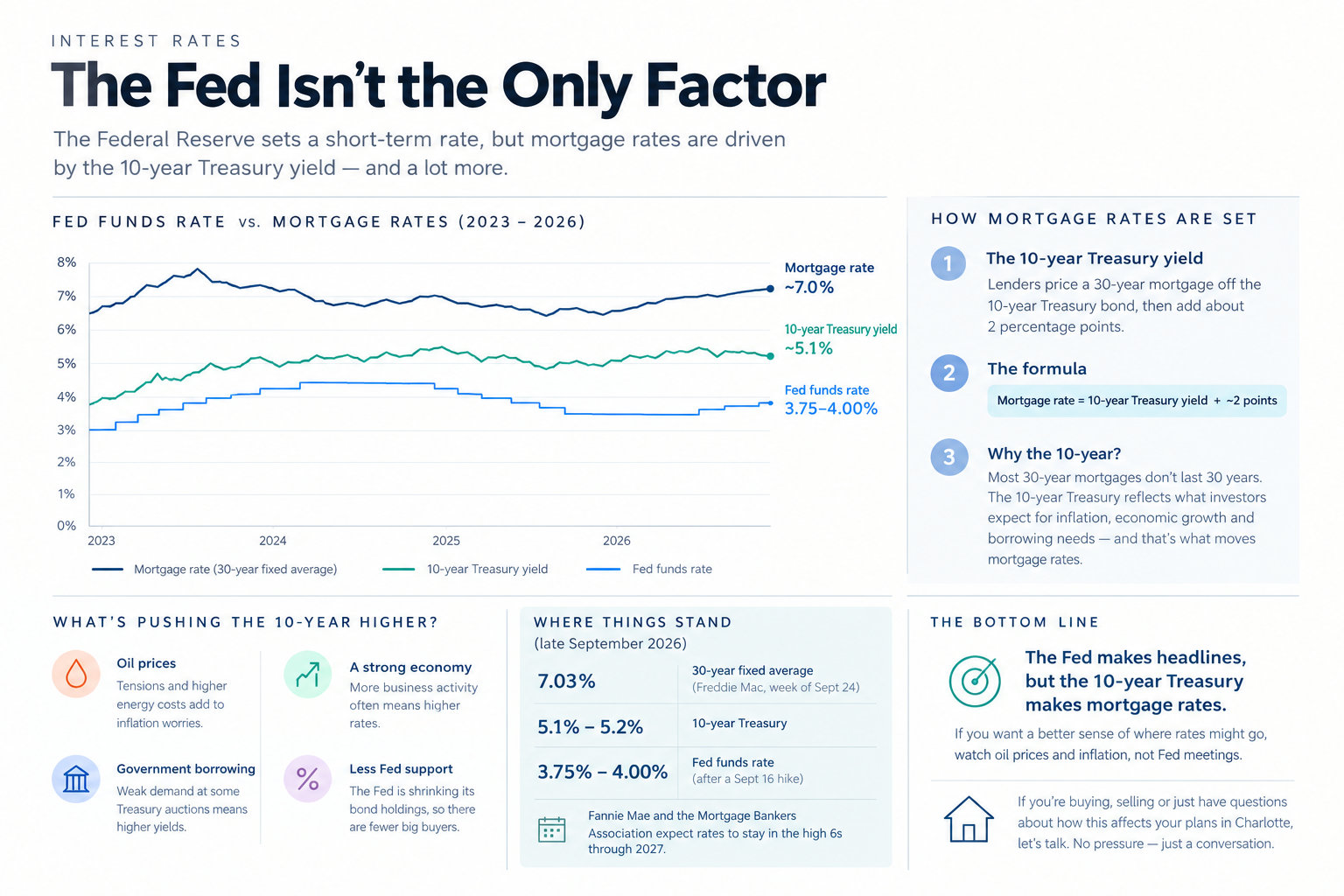
A 30-year mortgage is a different animal. Lenders price it off the 10-year Treasury bond, then add a cushion on top, usually around 2 percentage points. That cushion covers the risk that you'll refinance or sell early, plus the lender's costs.
So the simple formula is:
Mortgage rate = 10-year Treasury yield + about 2 points
Why the 10-year and not the 30-year bond? Because most 30-year mortgages don't actually last 30 years. People move or refinance, and on average a loan gets paid off in about a decade.
The 10-year Treasury is set by investors buying and selling bonds every day. What they care about most is where inflation is headed. If they expect higher inflation, they demand a higher return, and mortgage rates go up with it. The Fed influences that, but it doesn't control it.
The proof: 2024 through 2026
Here's how the Fed's rate and mortgage rates moved over the last few years:
- 2023: The Fed raised rates four times. Mortgage rates peaked near 7.8% in October.
- 2024: The Fed cut a full point in the fall. Mortgage rates averaged about 6.7% for the year and actually rose after the first cut.
- 2025: The Fed cut three more times. Mortgage rates drifted down slowly and ended the year around 6.2%.
- Early 2026: The Fed held steady. Mortgage rates dipped just under 6% in late February, the lowest since 2022, without any Fed move at all.
- Fall 2026: The Fed raised rates in September. Mortgage rates had already climbed back near 7%.
In total, the Fed lowered its rate by 1.75 points from its peak. Mortgage rates fell about a point at their best, and today they're right back where they started 2025.
Why the 10-year is climbing right now
The 10-year Treasury recently went above 5% for the first time since 2007. A few things are pushing it there at once:
- Oil prices. The conflict with Iran has pushed oil above $100 a barrel. Higher energy costs feed into inflation, and bond investors want to be paid for that risk.
- A strong economy. Business activity grew in September at its fastest pace in more than five years. A hot economy usually means higher rates.
- Lots of government borrowing. Some recent Treasury auctions drew weak demand, so the government has to offer higher yields to find buyers.
- Less help from the Fed. The Fed's new chair wants to shrink its large holdings of bonds over time. Fewer big buyers generally means higher long-term rates.
None of those are housing problems, and none of them will be fixed by a Fed rate cut. That's the key point.
Where things stand (late September 2026)
- 30-year fixed average: 7.03% (Freddie Mac, week of Sept 24)
- 10-year Treasury: about 5.1% to 5.2%
- Fed funds rate: 3.75% to 4.00%, after a quarter-point hike on Sept 16
As for where things go from here, Fannie Mae and the Mortgage Bankers Association both now expect rates to stay in the high 6s through 2027. It's worth knowing that in January, those same forecasters expected rates around 6% for this year and next. Events changed that fast.
I'm not going to predict rates, and I'd be careful with anyone who does. What I can tell you is what would need to happen for rates to come down meaningfully: oil prices and inflation would need to settle, and the 10-year Treasury would need to drop back toward 4%. If that happens, mortgage rates should follow, whether the Fed moves or not.
What this means if you're buying or selling in Charlotte
If you're buying: Don't build your plan around a Fed announcement. If the right home comes along and the payment works for your budget, that matters more than trying to time the rate. If rates drop later, refinancing may be an option. You can't go back and buy the house you passed on.
A few things are worth asking about in this market: seller concessions toward a rate buydown, assumable FHA or VA loans on some homes, and getting quotes from more than one lender. If you're looking at higher price points, ask specifically about jumbo loans. They're priced differently from standard loans, and sometimes more favorably.
If you're selling: Buyers are more focused on monthly payment than they were a few months ago. Pricing right from the start matters, and offering help with a buyer's rate can sometimes do more than a price reduction.
If you're moving up: You're probably sitting on a great rate and wondering if it's worth giving up. That's a real question, and the answer depends on your life, not just the numbers. Let's run both sides together before you decide.
The bottom line
The Fed makes headlines, but the 10-year Treasury makes mortgage rates. If you want a better sense of where rates might go, watch oil prices and inflation, not Fed meetings.
And if you're trying to figure out what any of this means for your own plans, I'm always happy to talk it through. No pressure, just a conversation.
Julie Will Fathom Realty | Charlotte, NC [email protected]
Rate data from Freddie Mac's Primary Mortgage Market Survey. Forecasts from Fannie Mae and the Mortgage Bankers Association as of September 2026. I'm a real estate agent, not a lender or financial advisor, so please talk with a lender about your specific situation.
Check out this article next